Introduction
Your customers don’t just search on Google anymore. They ask ChatGPT, Gemini, or Perplexity — and get instant answers without ever visiting your website. If your business isn’t showing up in those AI-powered results, you’re already invisible to a growing share of your market.
This is why AI automation for SEO is no longer optional. It’s the new foundation of digital growth for businesses in Punjab, Amritsar, and beyond. Whether you’re a startup founder, a service provider, or a decision-maker trying to scale — low traffic, weak leads, and flat revenue often trace back to one root cause: an outdated SEO strategy.
In this guide, we break down exactly how AI SEO strategy 2026, smart content marketing, and conversion rate optimization (CRO) work together to build a sustainable growth engine for your business.
What does SEO is the foundation of your website really mean?
Think of your website like a shop in Amritsar’s busiest market. SEO is the signboard, the location, and the word-of-mouth reputation that brings people to your door. Without it, the shop exists — but no one walks in.
In practical terms, SEO ensures that:
- Search engines understand what your business offers
- Your website appears when potential customers search for your services
- Your content answers real questions your audience is already asking
- Your site loads fast, works on mobile, and is easy to navigate
Without this foundation, every rupee you spend on ads, social media, or design is built on sand. SEO gives you organic, compounding traffic — the kind you don’t have to keep paying for.
Why traditional SEO is no longer enough
Changes in Google algorithms
Google has updated its algorithm dramatically since 2022. The Helpful Content System, the rise of SGE (Search Generative Experience), and Core Updates have fundamentally changed what it takes to rank. Keyword stuffing, cheap backlinks, and thin content not only fail — they actively hurt your site.
Today, Google rewards depth, authority, and genuine helpfulness. If your current SEO strategy was built more than two years ago, it’s likely working against you.
User intent and experience matter more than rankings
means nothing if your page doesn’t answer what the user actually wanted. Google now evaluates user intent — whether someone is looking to buy, to learn, or to compare — and rewards pages that match it precisely.
Experience signals like bounce rate, time on page, and Core Web Vitals are now ranking factors. SEO and user experience are inseparable in 2026.
What is a smart SEO strategy?
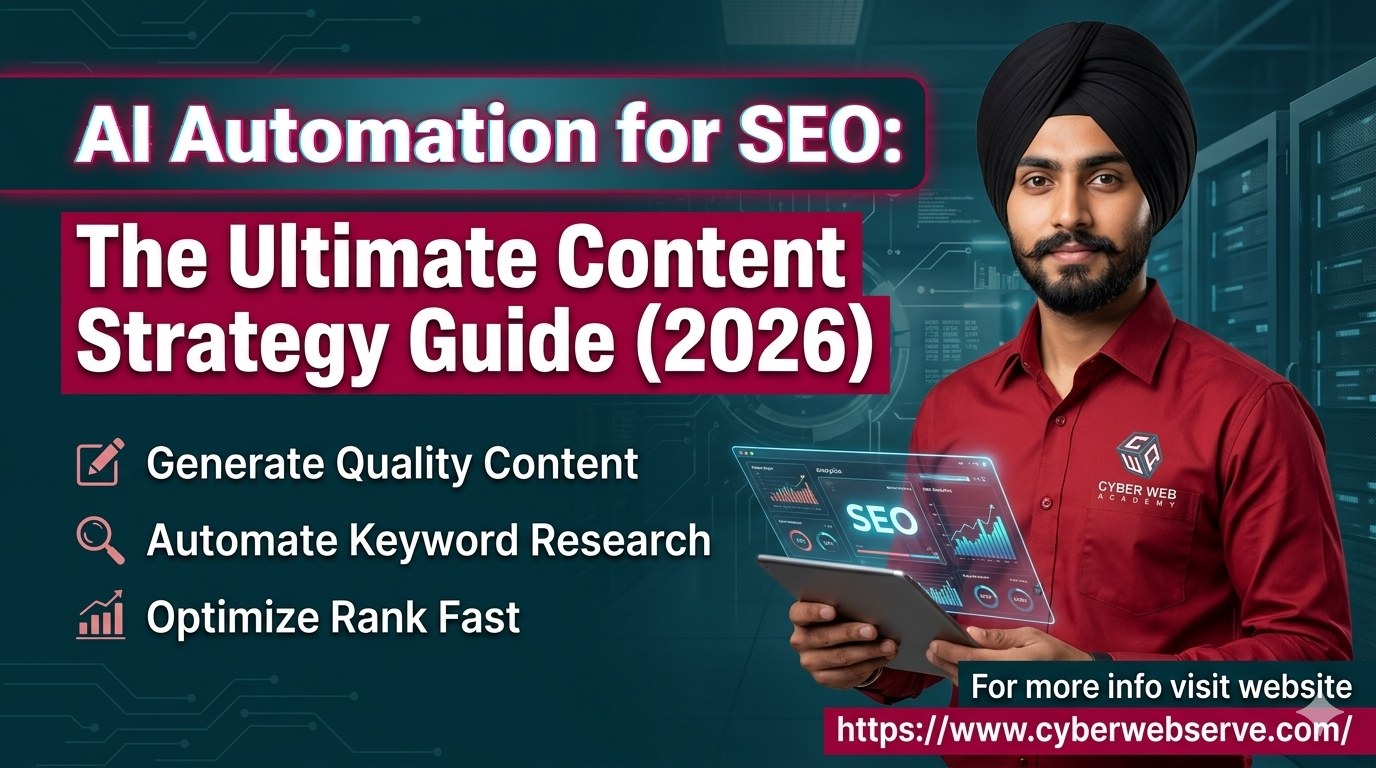
A smart SEO strategy in 2026 combines three elements: data-driven keyword research, authoritative content creation, and technical precision — all powered by AI automation for SEO.
It’s not about writing one blog post and hoping for the best. It’s about building a structured system where:
- Every page targets a specific search intent
- Content is continuously updated based on performance data
- Technical issues are caught and fixed proactively
- Your brand earns authority in your niche over time
This is what separates businesses that grow from businesses that plateau.
Role of AI SEO in modern website growth
How AI improves keyword research
Traditional keyword research meant pulling search volumes from a tool and guessing intent. AI SEO tools for content strategy in 2026 go much further. They analyze thousands of search queries simultaneously, cluster them by intent, identify content gaps your competitors haven’t filled, and predict which keywords are rising before they peak.
For businesses in Punjab and Amritsar, this means finding hyper-local, low-competition keywords that large national players overlook — giving you a real ranking advantage.
AI for content optimization and technical SEO
AI in content marketing doesn’t just generate articles. It audits your existing pages, identifies structural weaknesses, and recommends precise improvements — from internal linking to schema markup to heading hierarchy.
On the technical side, machine learning in SEO helps crawl your site at scale, flag slow pages, broken links, duplicate content, and indexation issues that would take a human team weeks to find manually.
Predictive SEO and automation
Automated content creation and predictive SEO tools can now forecast ranking opportunities 60–90 days in advance. They track competitor movements, monitor algorithm shifts, and alert you to gaps before your competitors can fill them. This is the power of AI-powered SEO: it doesn’t just react — it plans ahead.
What is CRO, and why SEO without CRO fails
Traffic vs conversions
Getting 10,000 visitors a month is meaningless if none of them become customers. Conversion Rate Optimization (CRO) is the practice of turning the traffic SEO brings you into actual revenue — leads, calls, sign-ups, and sales.
Many businesses in digital marketing SEO strategies focus entirely on rankings and ignore what happens after the click. That’s leaving money on the table.
User behavior, UX, and funnel optimization
CRO uses heatmaps, session recordings, A/B testing, and funnel analytics to understand exactly where visitors drop off and why. Then it fixes those friction points — improving page layout, calls-to-action, load speed, and trust signals.
The result: the same traffic generates significantly more business.
How SEO, AI SEO, and CRO work together as one growth system
Think of it this way:
- SEO brings the right people to your website
- AI SEO ensures you find those people faster, smarter, and at lower cost than your competition
- CRO ensures those visitors take action once they arrive
A real-world example: An Amritsar-based software company running on traditional SEO was getting steady traffic but almost no leads. After integrating AI SEO strategy (to target high-intent, local keywords) and CRO fixes (simplified contact form, clearer service pages), their qualified enquiries doubled within 90 days — without increasing their ad budget.
That’s the synergy. None of these three pillars work as well alone as they do together.
Our transparent and process-driven SEO methodology
Research and strategy planning
We begin every engagement with a full SEO audit, competitor analysis, and keyword mapping aligned to your business goals. No guesswork — every decision is backed by data.
SEO + AI execution
We deploy AI keyword research tools alongside proven on-page and off-page SEO techniques. Content is optimized for both human readers and search engines. Technical issues are resolved systematically, and authority is built through white-hat link acquisition.
Continuous optimization and reporting
We don’t disappear after setup. Every month, you receive transparent reporting on rankings, traffic, and conversions. We continuously test, refine, and improve — because SEO for business growth is a long-term commitment, not a one-time project.
Benefits of a growth-focused SEO approach for businesses
- Sustainable ROI: Organic traffic compounds over time — unlike paid ads that stop the moment you pause spend
- Higher quality leads: People who find you through SEO are already searching for what you offer
- Competitive advantage: AI SEO strategy for small businesses allows you to outrank larger competitors in local and niche markets
- Brand authority: Ranking consistently builds trust — both with search engines and with your audience
- Scalable growth: Website growth through SEO scales with your content and authority — not with your ad budget
- Future-readiness: AI automation in digital marketing positions your business to rank in both traditional and AI-powered search results
Why businesses choose smart SEO agencies over cheap SEO services
Cheap SEO is expensive in the long run. Low-quality backlinks, spun content, and black-hat tactics might deliver a short-term ranking bump — followed by a Google penalty that wipes out years of progress.
Smart businesses in Punjab and Amritsar are increasingly choosing SEO agency strategy built on transparency, expertise, and measurable results. They understand that generative AI for SEO, when used responsibly, accelerates growth — it doesn’t cut corners.
What differentiates a premium SEO partner:
- Clear reporting and accountability
- Strategy aligned to your specific business goals
- Knowledge of AI SEO vs traditional SEO differences
- Experience across both on-page and off-page SEO techniques
- A team that stays ahead of algorithm changes
SEO in the broadest sense is about growth
SEO is not a technical checkbox. It’s not a one-time project. And in 2026, it’s not something you can do without AI.
The future of AI in SEO belongs to businesses that treat it as a comprehensive growth system — one that attracts the right audience, builds genuine authority, and converts visitors into loyal customers. Whether you’re a startup in Amritsar or an established enterprise across Punjab, the principles are the same.
Build on the right foundation. Use smart tools. Optimize continuously. Grow sustainably.
Frequently asked questions
What is AI automation for SEO?
AI automation for SEO uses machine learning and AI tools to automate and enhance tasks like keyword research, content optimization, technical audits, and predictive ranking analysis — making SEO faster and more precise than manual methods.
How is AI SEO different from traditional SEO?
Traditional SEO relies heavily on manual research and human judgment. AI SEO uses algorithms to analyze large datasets, detect patterns, automate repetitive tasks, and make predictive decisions — giving you a significant speed and accuracy advantage.
Can small businesses in Punjab benefit from AI SEO?
Absolutely. AI SEO strategy for small businesses is especially powerful in local markets like Amritsar and Punjab, where identifying low-competition, high-intent keywords can deliver rankings faster than competing on broad national terms.
What are the best free and paid AI SEO tools?
Popular options include Surfer SEO, Semrush, Ahrefs, and Clearscope for paid tools. Free AI SEO tools include Google Search Console, Bing Webmaster Tools, and limited tiers of tools like Ubersuggest.
How long does AI-powered SEO take to show results?
Most businesses see measurable improvements in 60–90 days for local and long-tail keywords, with stronger domain-wide results building over 6–12 months. AI tools accelerate this timeline by prioritizing the highest-impact opportunities first.