A practical, future-ready guide for decision-makers who want measurable growth not vanity metrics.
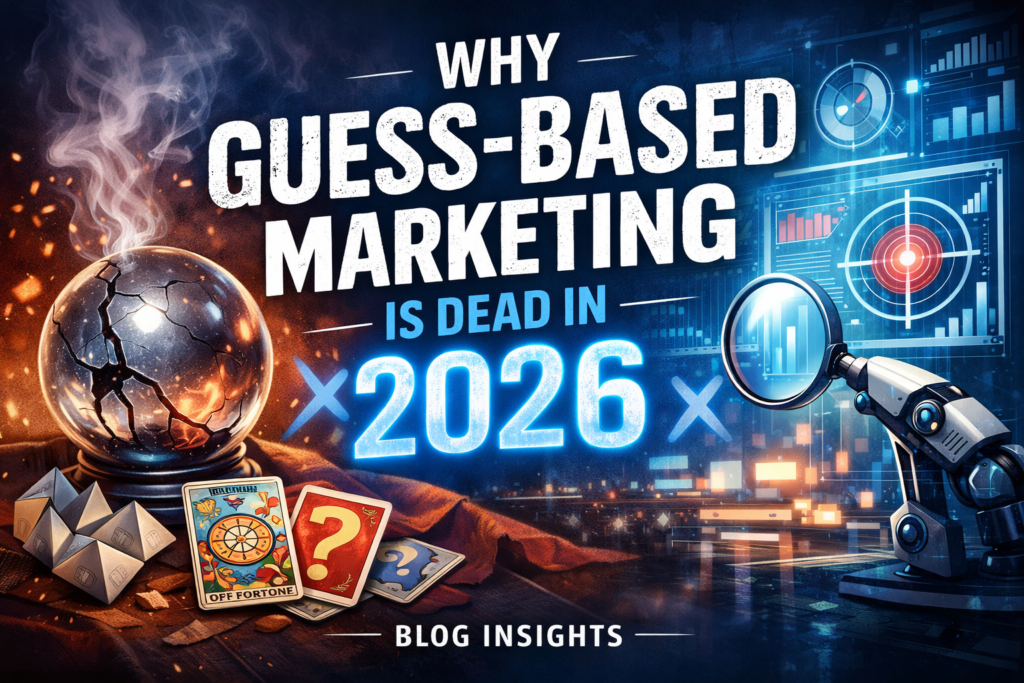
Why Guess-Based Marketing Is Dead in 2026
The digital marketing landscape has fundamentally changed. AI powered tools have democratized sophisticated analytics, automation has raised the baseline for competition, and advertising costs continue climbing across every major platform. What worked even two years ago running campaigns based on hunches, copying competitor tactics, or relying solely on creative intuition no longer delivers predictable results.
Modern Digital Marketing demands a different approach. Decision-makers in 2026 aren’t impressed by impressions or follower counts. They care about three things: predictable ROI, scalable systems, and clear accountability for every dollar spent. The gap between companies that guess and companies that measure has never been wider.
This article shows exactly how a data-driven strategy transforms marketing from a cost center into a growth engine. You’ll discover the frameworks that leading brands use to outperform competitors, the common mistakes that sabotage ROI, and the practical steps to implement this approach in your organization whether you’re working with an internal team or partnering with specialists.
What Data-Driven Digital Marketing Really Means (No Buzzwords)
Data-driven marketing isn’t about having more dashboards or generating prettier reports. It’s about moving from collection to action using insights to make better decisions faster than your competition.
The difference between collecting data and using data separates average performers from market leaders. Many organizations drown in metrics while starving for insights. They track everything but optimize nothing. True data-driven marketing creates a direct line from your marketing efforts to revenue, answering the questions that matter most: Which channels actually drive sales? What content moves prospects through the funnel? Where should we invest next quarter?
Leading brands treat data as a strategic asset, not a reporting obligation. They’ve discovered that the companies making decisions based on real-time performance data consistently outperform those relying on annual plans built on assumptions. The best part? This advantage compounds over time as your data gets richer and your insights get sharper.
The Core Pillars of a High-ROI Data-Driven Strategy
Building sustainable growth requires focusing on pillars that create long-term value rather than chasing short-term spikes. Here’s how the fundamentals of digital marketing transform when powered by data.
Search Engine Optimization as a Revenue Engine
Modern Search Engine Optimization has evolved far beyond keyword stuffing and backlink counts. Today’s SEO leverages search intent analysis, behavioral data, and conversion tracking to understand not just what people search for, but why they search and what makes them take action.
Data-driven SEO means predicting demand before competitors recognize the opportunity. By analyzing search trends, user behavior patterns, and conversion signals, you can identify high-value topics months before they peak. You can see which pages attract visitors but fail to convert, then optimize the experience based on real user data rather than guesswork.
The most powerful aspect of Search Engine Optimization is its compounding nature. Unlike paid advertising that stops the moment you pause spending, SEO builds an asset that grows stronger over time. Content you create today continues driving qualified traffic and generating leads in 2026, 2027, and beyond. When you layer data-driven optimization on top of this foundation, you create a revenue engine that scales without proportional cost increases.
Social Media Marketing Backed by Performance Data
Post consistently and engage with your audience is no longer a strategy it’s table stakes. In 2026, successful Social Media Marketing requires treating social channels as measurable sales drivers, not just brand awareness platforms.
Performance-driven social marketing leverages audience analytics to understand who actually converts, engagement signals to identify what content drives action, and attribution models to connect social interactions to revenue. This approach reveals which platforms deserve investment and which drain resources without returns.
The real breakthrough happens when you synchronize paid and organic social data. Organic content shows you what resonates authentically with your audience. Paid campaigns provide controlled testing environments and precise targeting. Together, they create a feedback loop that continuously improves both performance and efficiency. You stop guessing what your audience wants and start knowing what drives results.
Why a Data-Focused Social Media Marketing Agency Wins Faster
Specialized agencies bring three advantages that internal teams struggle to match: sophisticated tools that cost too much for single companies to justify, cross platform insights from managing multiple clients, and established testing frameworks that bypass months of trial and error.
Most in-house teams hit data blind spots because they lack the volume and variety needed to spot patterns. They might run one Facebook campaign while an experienced social media marketing agency analyzes hundreds, identifying exactly which creative formats, targeting parameters, and bidding strategies work best for specific objectives.
The right agency partner scales what works and ruthlessly eliminates what doesn’t. They’ve already made expensive mistakes with other clients’ budgets. They know which vanity metrics to ignore and which signals predict revenue. They bring proven playbooks while customizing them to your specific market position.
Decision-makers should demand complete ROI transparency from any agency partnership. You should see exactly how social media spend connects to pipeline and revenue, understand the attribution methodology, and have clear benchmarks for what success looks like at 30, 60, and 90 days.
How Data-Driven Digital Marketing Can 3× ROI (Step-by-Step)
Tripling your return on investment isn’t about working three times harder or spending three times more. It’s about eliminating waste, doubling down on what works, and making every dollar fight above its weight class.
Start by identifying high-impact channels using performance benchmarks.
Most companies spread budgets evenly across channels based on habit rather than results. Data reveals which channels drive the highest quality leads at the lowest cost. You might discover that LinkedIn generates leads that close at three times the rate of Facebook leads, even though the cost per lead is higher. This insight alone can transform your budget allocation.
Budget reallocation based on real attribution changes everything.
Instead of assigning credit to the last click before conversion, sophisticated attribution models show you the entire customer journey. You’ll see which touchpoints actually influence decisions and which just happen to be present when someone is already ready to buy. This visibility lets you invest in the channels that create demand, not just capture it.
Continuous optimization loops powered by live data create compound improvements.
Rather than running campaigns for weeks before reviewing performance, data-driven teams test and adjust daily. They identify underperforming ad sets within 48 hours and reallocate budgets to winners. They spot conversion rate drops immediately and diagnose the cause. These small, frequent optimizations accumulate into massive performance gains over quarters.
Realistic timelines matter for setting expectations.
In the first 90 days, expect to establish baseline data, identify quick wins, and eliminate obvious waste. The ROI improvement here might reach 30-50% simply by cutting what doesn’t work. Between 90 and 180 days, optimization compounds as you refine targeting, messaging, and channel mix based on what the data reveals. This phase often delivers another 50-70% improvement. From 180 to 365 days, sophisticated strategies like predictive modeling and advanced attribution mature, and your data asset becomes truly valuable. This is when tripling ROI becomes achievable for most organizations.
The 2026 Advantage: Future-Proofing Your Marketing Strategy
The gap between data-driven companies and everyone else will widen dramatically over the next few years. Several trends accelerate this divergence.
AI-assisted analytics and predictive modeling
have moved from experimental to essential. Machine learning algorithms now identify patterns humans miss, predict which leads will convert before sales teams even call them, and recommend budget allocations that optimize for business outcomes rather than marketing metrics. Companies investing in these capabilities today build advantages that competitors will struggle to match tomorrow.
Privacy-first tracking and first-party data strategies
determine who survives the cookieless future. Third-party data sources have already degraded significantly, and this trend accelerates. Organizations building robust first-party data ecosystems through owned communities, value-exchange relationships, and privacy-compliant tracking create moats that paid advertising alone cannot cross.
Cross-channel attribution serves as a competitive advantage
when most companies still use last-click models. Understanding how awareness campaigns on social media influence organic search behavior, or how email nurture sequences support paid conversion campaigns, allows for sophisticated strategies that appear like magic to competitors still operating in silos.
Companies investing seriously in data infrastructure, analytical capabilities, and decision-making processes today will dominate their markets tomorrow. The winners won’t necessarily outspend competitors; they’ll outsmart them with better information and faster optimization cycles.
Common Mistakes That Kill ROI (Even With Data)
Having access to data guarantees nothing. Many organizations invest in tools and tracking while making critical errors that sabotage results.
Chasing tools instead of insights tops the list. Companies buy expensive platforms, implement complex tracking, and generate beautiful reports while failing to change a single decision based on what the data reveals. Tools enable insights, but they don’t replace strategic thinking or organizational commitment to data-driven decision-making.
Misreading vanity metrics as success
destroys countless marketing budgets. Increasing website traffic by 50% means nothing if conversion rates drop and revenue stays flat. Growing your social media following feels good but rarely correlates with business outcomes. Data-driven organizations obsess over metrics that directly connect to revenue and customer lifetime value.
Fragmented data across platforms
creates blind spots that lead to poor decisions. When your advertising data lives in one system, website analytics in another, CRM data in a third, and sales information in a fourth, you can’t see the complete picture. Integration isn’t optional for serious data-driven marketing, it’s foundational.
Treating Digital Marketing as a cost center instead of a growth engine
reflects a fundamental misunderstanding. When marketing is viewed as an expense to minimize rather than an investment to optimize, organizations underinvest in the data infrastructure, talent, and testing required to achieve breakthrough results. The most successful companies flip this mindset, asking not “how little can we spend on marketing” but “how much profitable growth can marketing deliver with proper investment.
What Decision-Makers Should Do Next
If you’re responsible for marketing performance, several questions will reveal whether your current approach is future-ready.
Ask your marketing team or agency:
How do you attribute revenue to specific campaigns? What’s our current customer acquisition cost by channel, and how has it trended over the past six months? Which campaigns should we kill today based on performance data? If you receive vague answers or requests for more time to pull reports, you have a data problem.
Metrics that actually matter at the leadership level
include customer acquisition cost, customer lifetime value, marketing-influenced revenue, conversion rates by channel and campaign, and return on ad spend. Notice what’s missing: impressions, reach, followers, and other awareness metrics. Those may play supporting roles, but they shouldn’t drive strategy.
Evaluate whether your current strategy is future-ready
by examining your first-party data collection practices, cross-channel attribution capabilities, testing velocity, and organizational willingness to make decisions based on data rather than opinions. If you’re not systematically testing new approaches, you’re falling behind competitors who are.
First steps toward building a data-driven culture
start with leadership commitment. When executives consistently ask “what does the data show” before approving campaigns, the entire organization shifts. Invest in integration before new channels connecting existing data sources delivers more value than adding new ones. Start small with testing, but start immediately. Even simple A/B tests build the muscle memory your team needs for more sophisticated approaches.
Data Is the Strategy in 2026
ROI growth no longer comes from doing more of everything. It comes from doing the right things with precision and continuously improving based on what the data reveals. The organizations that thrive over the next few years won’t necessarily have the biggest budgets; they’ll have the best information and the fastest learning cycles.
The compounding power of data-driven decisions creates exponential advantages over time. Every campaign teaches you something about your market, every test refines your understanding of what works, and every optimization makes the next one more effective. This is how you build sustainable competitive advantages in Digital Marketing.
Here’s the final takeaway for executives and founders: the quality of your marketing decisions determines the growth trajectory of your business. When those decisions rely on intuition and incomplete information, you’re gambling. When they’re guided by comprehensive data and rigorous analysis, you’re investing strategically in predictable growth.
It’s time to rethink how your marketing decisions are made.
Audit your current data capabilities, demand transparency from your team or agency partners, and commit to building the infrastructure that separates market leaders from everyone else. The companies that treat data as a strategic asset in 2026 will be the ones celebrating triple-digit ROI growth while competitors wonder what happened.
The question isn’t whether to become data-driven, it’s whether you’ll do it before your competitors do.
Top 5 FAQs
1. What is a data-driven digital marketing strategy?
A data-driven digital marketing strategy uses real data—like website analytics, ad performance, user behavior, and conversion metrics—to make marketing decisions. Instead of guessing what might work, businesses rely on insights to optimize campaigns, targeting, and budgets for better ROI.
2. How does data-driven marketing increase ROI?
It increases ROI by:
- Focusing budget on high-performing channels
- Eliminating campaigns that don’t convert
- Improving targeting and personalization
- Continuously optimizing ads, content, and landing pages
This means less wasted spend and more revenue from the same budget.
3. Which data is most important for digital marketing in 2026?
In 2026, the most important data points include:
- Customer behavior data (clicks, time on site, journey paths)
- Conversion and attribution data
- First-party data (email lists, CRM data)
- AI-powered predictive insights
These help businesses adapt to privacy changes and smarter algorithms.
4. Is data-driven marketing only for big companies?
No. Small and mid-sized businesses benefit even more because data helps them spend wisely. With tools like Google Analytics 4, Meta Ads Manager, and CRM dashboards, even startups can track performance and scale what works without wasting money.
5. How long does it take to see ROI from a data-driven strategy?
Some improvements (like better ad targeting) can show results in weeks. However, consistent 2×–3× ROI growth usually happens over 3–6 months, as data accumulates and optimizations compound over time.
🔚 Conclusion
A data-driven digital marketing strategy isn’t a trend—it’s the foundation of profitable marketing in 2026. Businesses that rely on assumptions and vanity metrics will continue to struggle, while those that track, analyze, and optimize based on real data will win consistently.
By understanding customer behavior, doubling down on what converts, and continuously refining campaigns, brands can easily 3× their ROI without increasing budgets. The key is simple: stop guessing, start measuring, and let data guide every marketing decision